Published by FMLTEA | Matcha Industry Insights | 2026
China and Japan are the two major origins shaping the global matcha supply chain, but they serve different market needs. Japan is strongly associated with traditional matcha culture and premium tea ceremony products, while China has developed large-scale production capabilities to serve food manufacturers, beverage brands, bubble tea chains, and international ingredient buyers.
For importers and B2B procurement teams, choosing between Chinese and Japanese matcha involves more than comparing country of origin. Production capacity, raw material selection, processing technology, flavor profile, price, food safety compliance, and supply continuity all play important roles.
This guide compares the Chinese and Japanese matcha industries, examines key production regions and grade differences, and explains how international buyers can select the right matcha powder for their business.
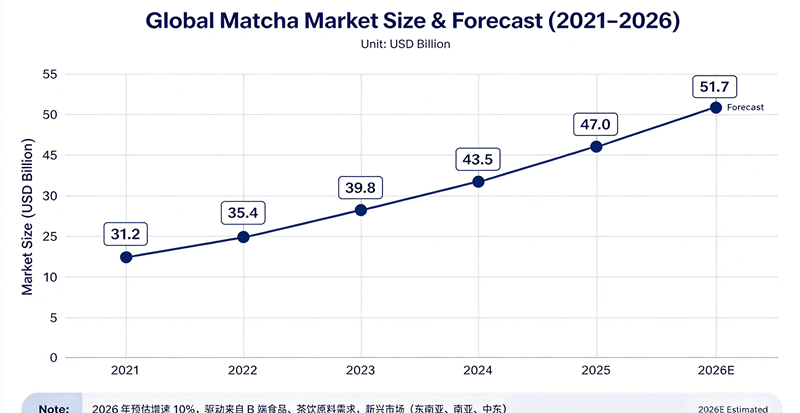
1. Global Matcha Market Overview in 2026
1.1 Market Growth and Key Demand Drivers
Matcha has evolved from a traditional powdered green tea into a widely used ingredient across the global food and beverage industry. Its applications now extend beyond traditional tea preparation to matcha lattes, bubble tea, ready-to-drink beverages, bakery products, ice cream, confectionery, and powdered beverage mixes.
Market research firms publish different global matcha market estimates because their definitions, product categories, and forecasting methods vary. For example, Fortune Business Insights estimated the market at US$2.32 billion in 2025, while other research firms reported substantially higher figures. These estimates should therefore be compared only after checking their respective market definitions. Source: Fortune Business Insights.
Several factors are driving demand for commercial matcha powder:
1. Growing interest in green tea beverages
Matcha has become a popular option for specialty cafés, coffee shops, and beverage chains seeking alternatives to conventional coffee and tea drinks. Matcha lattes, iced matcha, and flavored matcha beverages create demand for different grades and flavor profiles.
2. Expansion of bubble tea and beverage manufacturing
Commercial beverage producers require matcha that performs consistently in milk-based drinks, plant-based beverages, syrups, and powdered premixes. For these applications, color stability, dispersibility, bitterness, and cost per serving are often as important as the origin.
3. Wider applications in food manufacturing
Matcha powder is used in cakes, cookies, chocolate, ice cream, fillings, noodles, and other processed foods. Manufacturers typically evaluate color, flavor intensity, heat-processing performance, and formulation cost when selecting a supplier.
4. Demand for traceable and compliant ingredients
Importers increasingly evaluate supplier documentation, pesticide residue compliance, heavy metal testing, traceability, and applicable organic certification. These requirements are particularly important for products entering regulated markets such as the United States and the European Union.
1.2 China and Japan: Two Different Supply Chain Roles
China’s matcha industry is increasingly important to large-volume ingredient procurement. According to industry reporting from the China Tea Marketing Association, China’s matcha output exceeded 12,000 metric tons in 2025. This figure is a reported industry estimate and should be distinguished from independently verified global production statistics. Source: China Tea Marketing Association.
Japan remains a leading origin for premium matcha associated with traditional Japanese tea culture. Its tencha production—the shade-grown, processed leaf material used to make matcha—reached 5,336 metric tons in 2024, according to figures reported by Reuters citing Japanese tea industry data. Tencha production should not be confused with finished matcha powder output, because processing yields and product specifications differ. Source: Reuters.
The distinction matters for procurement:
- China: Particularly relevant for scalable ingredient sourcing, food manufacturing, beverage applications, and customized B2B supply programs.
- Japan: Particularly associated with traditional matcha heritage, premium origin positioning, and specialty tea products.
Neither origin automatically guarantees a particular grade. Buyers should evaluate the actual product specification, sensory performance, testing results, and consistency of each supplier.
2.2 Key Matcha-Producing Regions in China
Guizhou: Tongren and surrounding areas
Guizhou has become an important base for commercial matcha production. Its tea-growing environment, developing processing infrastructure, and investment in matcha manufacturing have supported the growth of export-oriented production.
In February 2025, the China Tea Marketing Association reported that a 36-metric-ton shipment of European-standard matcha from Tongren was dispatched to North America. The report also described the region’s expanding international market activity. Source: China Tea Marketing Association.
Zhejiang: Jingshan, Wuyi, and surrounding tea-producing areas
Zhejiang has an established tea industry and a broad processing supply chain. These capabilities can support different tea powder specifications and commercial applications, depending on the producer’s raw materials and equipment.
For buyers, the most useful comparison is not simply the province of origin. It is whether a supplier can consistently deliver the required color, flavor, particle size, microbiological quality, and residue compliance.
2.3 Why Chinese Matcha Is Relevant to B2B Buyers
Chinese matcha offers several potential advantages for commercial sourcing:
- Scalable supply: Suitable producers may support repeat orders and larger-volume procurement.
- Flexible processing: Different milling and production methods can serve beverage and food manufacturing needs.
- Competitive cost structure: Production scale and processing efficiency may provide cost advantages, depending on grade and specification.
- Product customization: Qualified suppliers may offer tailored color, flavor, particle size, packaging, and application-specific specifications.
China’s industry is also moving beyond basic culinary applications. Premium drinking-grade products are available from some producers, but buyers should validate each product through samples, specifications, and batch-level quality documentation rather than assuming that all products from a particular origin are equivalent.
3. Japan’s Matcha Industry: Heritage, Premium Positioning, and Supply Constraints
3.1 Major Japanese Matcha-Producing Regions
Japanese matcha is associated with several established tea-producing regions, including:
- Uji, Kyoto: Strong recognition in traditional Japanese tea culture and premium matcha.
- Nishio, Aichi: An established matcha-producing area with commercial processing expertise.
- Shizuoka: A major tea-producing region with a broad tea-processing industry.
- Kagoshima: An important tea-producing region that has expanded its role in Japanese tea production.
Origin can influence consumer perception and product positioning, but the region alone does not establish the quality of an individual batch.
3.2 Tencha Production and Supply Availability
Japanese matcha production depends on tencha cultivation, specialized processing, and subsequent grinding. Expanding production requires suitable land, investment, skilled labor, and time for new tea plantings to become productive.
Strong international demand has also placed pressure on parts of Japan’s matcha supply chain. Reuters reported that weather-related crop challenges and rising demand contributed to supply pressure and higher prices in 2025. Source: Reuters.
For importers, this makes forward planning important. Buyers should confirm current availability, allocation policies, harvest periods, lead times, and the supplier’s ability to maintain consistent specifications across repeat orders.
Japanese matcha can be an excellent choice for premium products, but buyers should not assume that every Japanese supplier can fulfill large industrial orders at short notice. Availability depends on grade, harvest, supplier inventory, and order size.
4. China vs. Japan Matcha: Planting, Raw Materials, and Processing
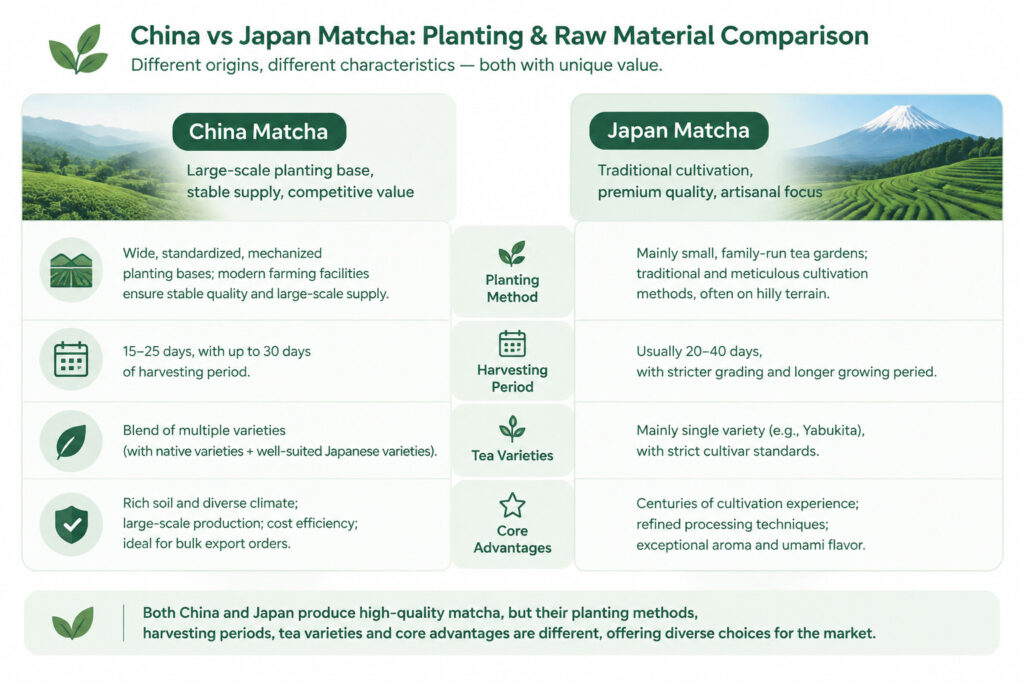
4.1 Planting Methods and Raw Material Selection
Shade duration, harvesting method, cultivar, leaf maturity, and raw material selection can all influence matcha’s color, aroma, bitterness, and umami.
It is important not to treat either country as having one uniform production method. Practices differ by producer and product grade.
4.2 Grinding Technology and Product Quality
Matcha is produced by processing suitable tea leaves into a fine powder. Different manufacturers use different milling technologies, depending on their target particle size, production volume, flavor profile, and cost requirements.
Traditional stone milling
Stone milling is associated with traditional premium matcha production. It can provide a controlled, relatively slow grinding process, but output is limited and production costs may be higher.
Industrial milling
Commercial manufacturers use technologies such as ball milling and other fine-grinding systems to achieve the output required for larger orders. Performance depends on equipment design, operating conditions, temperature control, and quality management.
Industrial milling is not automatically inferior, and stone milling is not by itself proof of superior quality. The finished powder should be evaluated for color, aroma, texture, taste, particle size, and performance in its intended application.
For procurement teams, the key question is whether the processing method produces the required sensory and technical characteristics consistently at the desired order volume.
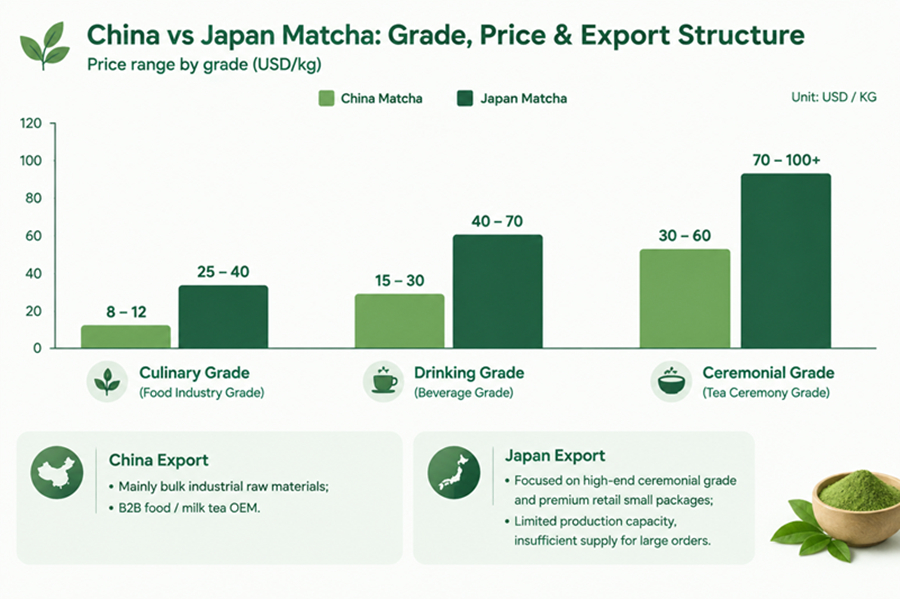
4.3 Matcha Grades: Culinary, Drinking, and Ceremonial
International matcha trade commonly uses the terms culinary grade, drinking grade, and ceremonial grade. However, these terms do not constitute one universally standardized grading system across all suppliers and markets.
| Grade | Typical applications | Main purchasing considerations |
|---|---|---|
| Culinary grade | Baking, confectionery, ice cream, food manufacturing | Color retention, flavor intensity, heat-processing performance, cost |
| Drinking grade | Matcha lattes, bubble tea, smoothies, specialty beverages | Flavor balance, bitterness, color, dispersibility, cost per serving |
| Ceremonial grade | Traditional-style preparation and premium direct consumption | Aroma, umami, sweetness, bitterness, texture, and overall sensory quality |
The exact meaning of each grade depends on the supplier’s specification. Buyers should request measurable criteria and sensory references rather than relying on the grade name alone.
For a commercial matcha latte, for example, a well-selected drinking-grade matcha may offer better formulation economics than a premium product intended primarily for traditional preparation.
In the end
The global matcha market in 2026 presents a pattern of “Japan guarding high-end, China guarding bulk”. Japanese matcha relies on its culture and brand to dominate the high-end tea ceremony market, but its production capacity is limited, making it difficult to meet the explosive demand for raw materials in the global food and beverage industry. China, with its large-scale tea gardens and complete processing industry chain, has become the core supplier of matcha worldwide, gradually extending its products from basic food grade to high-end drinking grade.
In the next few years, the global B-end procurement trend will change: bulk milk tea, baking, and RTD beverage customers will gradually shift towards purchasing compliant, high-quality matcha from China with complete batch testing certificates; And high-end retail and tea ceremony scenes will continue to choose Japanese matcha. For Chinese matcha exporters, standardized grading, full set of international certifications, batch COA, and stable quality are the core competitiveness to seize the overseas incremental market.